Advanced Biofilm Engineering
1. What is MBBR (Moving Bed Biofilm Reactor) Technology?
MBBR (Moving Bed Biofilm Reactor) is an advanced biological wastewater treatment process that combines the high-rate advantages of attached-growth biofilm processes with the operational flexibility of suspended-growth activated sludge. Instead of relying on fragile suspended flocs, specialized heterotrophic and autotrophic nitrifying bacteria grow as a dense, robust biofilm attached to millions of microscopic virgin HDPE plastic carriers (K1, K3, or K5 media).
- Fluidized Media Circulation: The biofilm carriers are kept in continuous suspension and motion throughout the aeration reactor using coarse bubble diffusers (aerobic zones) or mechanical submersible mixers (anoxic denitrification zones).
- Massive Active Surface Area: High-geometry carriers provide protected specific surface areas ranging from 800 m²/m³ to over 1,200 m²/m³, concentrating 3 to 5 times more active biomass per cubic meter than conventional aeration basins.
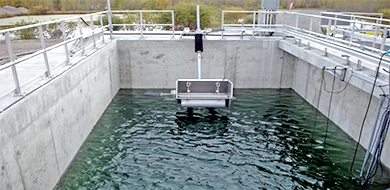
- Perforated Retention Sieve Screens: Stainless steel wedge-wire retention sieves at the reactor outlet keep the bio-media carriers securely inside the tank while allowing treated water to flow seamlessly to secondary clarification.
Commercial & Municipal
2. MBBR Package Sewage Treatment Plants (STP) for Sri Lanka
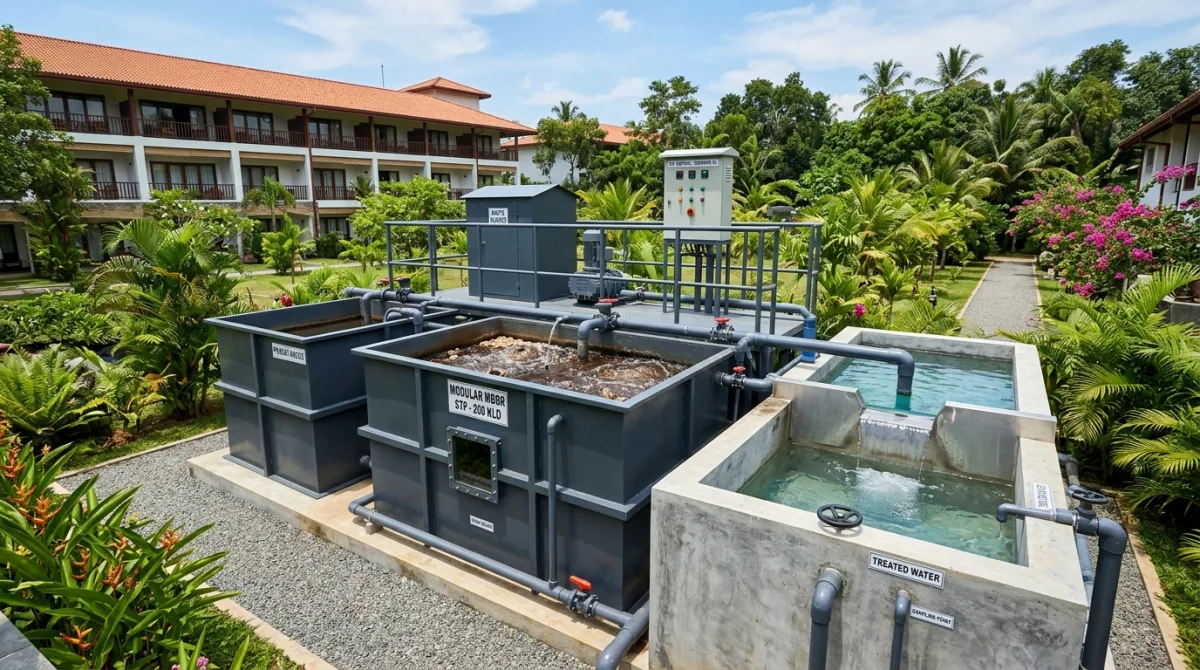
For Sri Lankan hotels, beach resorts, hospitals, educational institutions, condominiums, and commercial office complexes, land footprint and odor control are critical constraints. Water Lanka’s packaged MBBR STPs provide the ideal solution:
- 50% Smaller Footprint: By eliminating large secondary sludge recirculation (RAS) loops and operating at much higher biomass concentrations (MLSS equivalent of 8,000–12,000 mg/L), MBBR tanks require half the civil area of conventional Activated Sludge Plants (ASP).
- 100% Odorless & Silent Operation: Fully enclosed reactors with acoustic-enclosed Roots air blowers and submerged coarse-bubble aeration grids make MBBR systems suitable for underground basements or near guest rooms.
- Resilience to Seasonal Shock Loads: Attached biofilms resist hydraulic surges and organic starvation during low-occupancy seasons (common in tourist hotels), recovering full biological activity within hours.
- Treated Water Reusability: Effluent from secondary lamella settling and sand/carbon filtration easily meets Central Environmental Authority (CEA) discharge limits and is reusable for toilet flushing and garden irrigation.

Industrial ETP
3. Industrial MBBR for High-Strength & Toxic Effluents
Industrial effluents from textile dyeing, garment washing, dairy factories, breweries, rubber processing, and pharmaceuticals present high chemical oxygen demand (COD), fluctuating temperatures, and toxic surfactants that disrupt conventional biological plants.
- High Nitrification Performance: MBBR carriers protect slow-growing autotrophic nitrifying bacteria on the interior protected surface, achieving complete conversion of Ammonia Nitrogen (NH4-N) to nitrate even in the presence of inhibitory industrial chemicals.
- Two-Stage Anaerobic / Aerobic MBBR: Water Lanka engineers sequential multi-stage MBBR trains where an initial anoxic/anaerobic MBBR stage breaks down refractory cyclic hydrocarbons, followed by aerobic MBBR polishing for > 95% overall COD removal.
- No Sludge Bulking: Unlike activated sludge where filamentous bacteria cause sludge bulking and clarifier carryover, MBBR operates with attached biofilms that never bulk, ensuring stable settling and sludge dewateability.
Double Your Plant Capacity: MBBR Retrofit for Existing Aeration Tanks
Is your existing activated sludge or extended aeration plant in Sri Lanka struggling with increased wastewater volume or failing CEA discharge limits? You do not need to pour new concrete tanks or acquire expensive land. Water Lanka Services can convert your existing aeration basin into an ultra-high-rate MBBR:
1. Install Retention Sieves
We mount heavy-duty stainless steel AISI 304/316 wedge-wire outlet retention screens on your existing overflow weirs, tailored to prevent media loss under peak hydraulic flows.
2. Upgrade Aeration Grid
We install a non-clogging stainless steel coarse-bubble aeration grid across the tank floor, providing powerful fluidization turbulence that prevents bio-carrier stagnation and dead zones.
3. Charge K1/K3 Bio-Media
We charge virgin HDPE bio-carrier media at 40% to 65% tank volume fill, immediately boosting treatment capacity by 150% to 200% without expanding the physical plant footprint.
MBBR Technical Parameters & Performance Specifications
| Technical Parameter |
Standard MBBR Specification |
Conventional Activated Sludge (ASP) |
Water Lanka Advantage |
| Bio-Carrier Material |
100% Virgin High-Density Polyethylene (HDPE) |
None (Suspended flocs only) |
> 20-year media lifespan without degradation |
| Protected Surface Area |
800 – 1,200 m²/m³ (K1, K3, K5) |
100 – 200 m²/m³ equivalent |
5x higher active bacterial biomass density |
| Media Fill Ratio |
30% – 67% of reactor volume |
Not applicable |
Expandable capacity by adding more media later |
| Hydraulic Retention Time (HRT) |
3 – 6 Hours |
12 – 24 Hours |
Significantly smaller reactor tank volume |
| BOD5 Removal Efficiency |
95% – 98% |
80% – 90% |
Guaranteed CEA Inland Discharge Compliance |
| Ammonia (NH4-N) Removal |
90% – 95% (High Nitrification) |
60% – 75% |
Thick biofilm protects nitrifiers from cold/toxins |
| Sludge Recirculation (RAS) |
None Required |
100% continuous pumping required |
Eliminates RAS pumps, pipes & energy costs |
Why is MBBR superior to conventional activated sludge for hotels and hospitals in Sri Lanka?
MBBR plants require 40% to 50% less physical footprint, generate zero biological odor, operate with silent acoustic blowers, and do not suffer from sludge bulking or settling failures. In addition, when hotel occupancy fluctuates from 20% to 100%, the attached biofilm on the K1 carriers survives starvation without dying off, providing instant biological recovery upon load resumption.
What type of bio-carrier media does Water Lanka supply?
Water Lanka supplies 100% virgin high-density polyethylene (HDPE) bio-carrier media in K1 (dia 11mm, surface area > 850 m²/m³), K3 (dia 25mm, surface area > 600 m²/m³), and K5 high-capacity media. Our media has a density of 0.96–0.98 g/cm³, ensuring effortless fluidization and circular tumbling when aerated.
Does MBBR effluent comply with Central Environmental Authority (CEA) discharge standards?
Yes. Our MBBR systems consistently discharge treated effluent with BOD5 < 20 mg/L (CEA limit: 30 mg/L), COD < 100 mg/L (CEA limit: 250 mg/L), and TSS < 25 mg/L (CEA limit: 50 mg/L), fully eligible for an Environmental Protection License (EPL) and safe for garden irrigation.